-
Who Are the Sidelined 2%
750,000
Canadians
Multiple
Overlapping Health and Social Issues
2%
of the population
Who Are the Sidelined 2%?
Jo is not hard to reach.
Jo is hard to treat.
Meet Jo.
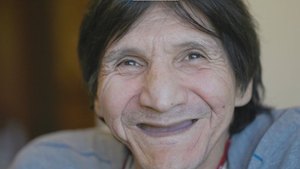
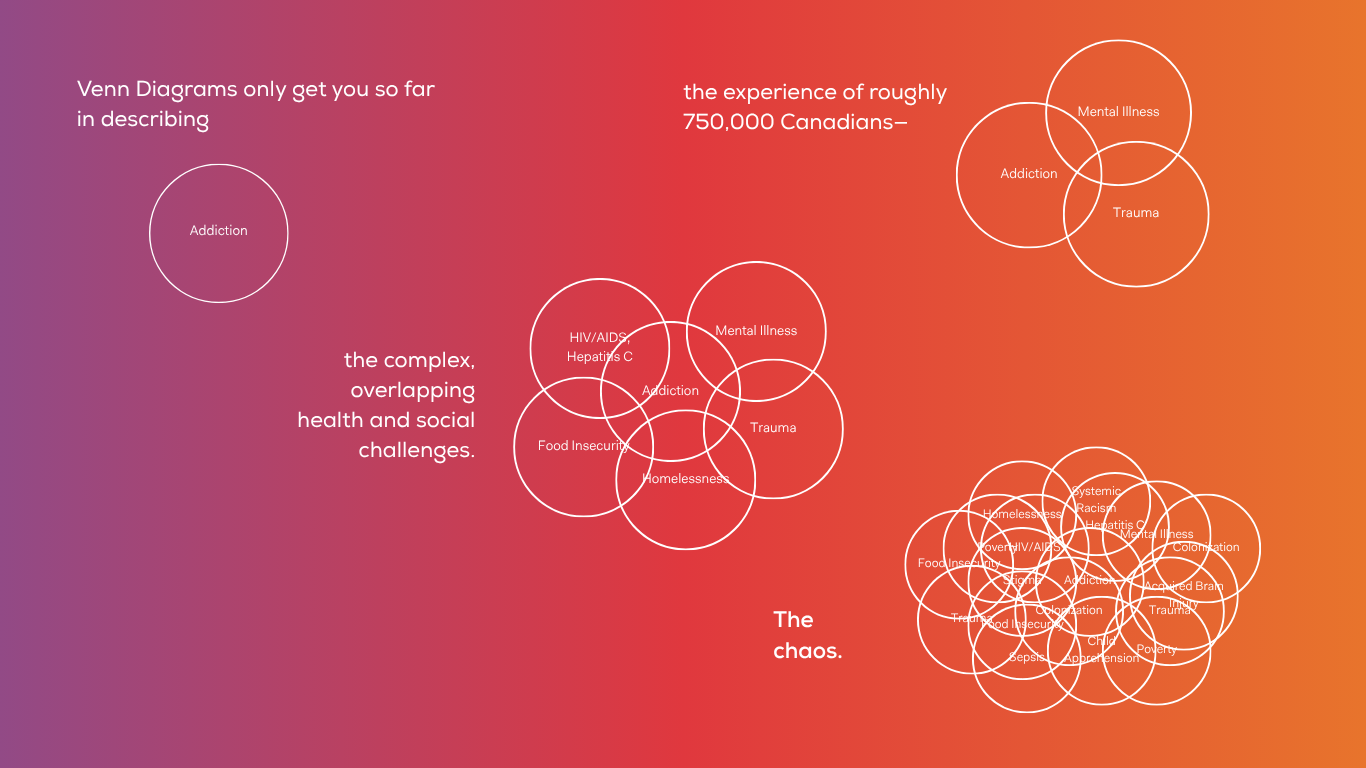
Jo isn’t one specific person, but a composite character created from the lived experiences of roughly 750,000 Canadians. In this way, Jo is very real—the embodiment of a population forced to navigate daily life at the intersection of multiple, overlapping challenges.
Jo lives with chronic conditions, has a history of trauma, struggles with mental health and substance use, faces barriers to stable housing and income, and more. Jo regularly accesses health and social services, but these systems aren’t built to communicate with each other— often leaving Jo to navigate alone.
People like Jo are often referred to as having “complex care needs.” They make up about 2% of the population, yet account for a disproportionately high use of health, housing, justice, and social systems. Their needs are not just medical—they are layered, intersectional, and deeply shaped by structural inequities.
Across Canada, frontline organizations work tirelessly to support people with overlapping health, housing, and social needs. But even the most dedicated teams are operating within systems that weren’t built for complexity—where care is often fragmented, funding siloed, and collaboration made difficult by structural barriers.
Without intentional cross-sector coordination, sustainable investments, and community-led solutions, many of the 750,000 Canadians with the most complex care needs will continue to fall through the cracks. What lies underneath those cracks isn’t recovery—it’s more preventable deaths, deeper marginalization, and escalating crises that no single organization can solve alone.
To “use a sidelined 2% lens” means to design, fund, and evaluate your work with people in mind—not mandates. It’s about asking: Would this work for Jo?
If not, what needs to change?
.jpg)
.jpg)